
NDIS Support Coordination: Helping You Navigate Your NDIS Journey with Confidence

Receiving an NDIS plan can be life-changing. For many people living with disability, it opens the door to greater independence, improved wellbeing, meaningful community participation and access to supports that can make everyday life easier. However, receiving an NDIS plan is often just the beginning. Many participants and families quickly discover that understanding funding categories, finding suitable providers, coordinating multiple supports and preparing for future plan reviews can be overwhelming. This is where NDIS Support Coordination, also known as Coordination of Supports, can make a significant difference. At Caring Arms Australia, we believe every participant deserves to feel confident, informed and in control of their supports. Support Coordination is designed to help you understand your options, connect with the right services and build the skills needed to get the most from your NDIS plan. What Is NDIS Support Coordination? Support Coordination is a Capacity Building support funded through the National Disability Insurance Scheme (NDIS). Its purpose is to help participants understand, implement and maximise their NDIS plans. A Support Coordinator works alongside participants to: Understand NDIS funding Connect with service providers Coordinate multiple supports Build independence and confidence Resolve service-related challenges Prepare for plan reviews Achieve personal goals Importantly, Support Coordination is not about making decisions for you. It is about helping you make informed decisions and ensuring you remain at the centre of every choice. The NDIS was built on the principles of choice and control, and Support Coordination helps participants exercise both. Why Many NDIS Participants Benefit from Support Coordination The NDIS provides flexibility and choice, but that flexibility can sometimes feel overwhelming. Many participants ask: What can my funding be used for? How do I find the right providers? What happens if my support needs change? How do I prepare for my next plan review? How do I know if my current supports are working? Support Coordination helps answer these questions and provides guidance every step of the way. Instead of trying to navigate the system alone, participants have someone who can help them understand their options and connect the pieces together. Understanding the Different Levels of Support Coordination Support Connection Support Connection is designed for participants who need some assistance understanding and implementing their NDIS plan. The focus is on helping participants connect with providers and begin using their supports effectively. This level is generally suitable for participants with less complex needs who require some guidance while building confidence and independence. Support Coordination Support Coordination is the most commonly funded level. A Support Coordinator helps participants: Understand their plan Connect with service providers Coordinate supports Build capacity and independence Resolve barriers Monitor progress towards goals This level of support is suitable for many participants who have multiple providers or need assistance managing their NDIS journey. Specialist Support Coordination Specialist Support Coordination is designed for participants with more complex situations. This may include: Complex disability support needs Psychosocial disability Housing challenges Hospital discharge planning Justice system involvement High-risk situations Multiple service systems Specialist Support Coordinators help navigate these complexities while building sustainable support arrangements. How a Support Coordinator Can Help You Every participant's journey is different. A good Support Coordinator takes the time to understand your goals, preferences and circumstances. Understanding Your NDIS Plan Many participants receive their plan but are unsure how to use it effectively. Support Coordinators help explain: Funding categories Capacity Building supports Core Supports Capital Supports Service agreements Budget management When you understand your funding, you are better positioned to make informed decisions. Finding the Right Providers Choosing providers can be challenging. There may be multiple options available, each offering different services, approaches and availability. A Support Coordinator can help you identify providers that align with your goals, communication preferences, cultural needs and support requirements. Coordinating Multiple Supports Many participants receive services from: Support workers Therapists Allied health professionals SIL providers SDA providers Community programs Employment services Medical professionals Support Coordination helps ensure everyone is working together towards the same goals. Building Your Independence One of the key aims of Support Coordination is capacity building. Rather than creating dependence, Support Coordination helps participants develop the confidence and skills needed to manage supports more independently over time. Support Coordination and NDIS Housing Pathways Many participants explore housing options through the NDIS. This may include: Supported Independent Living (SIL) Supported Independent Living provides assistance with daily tasks while living in shared or individual accommodation. Support Coordinators can help participants: Understand SIL funding Explore housing options Connect with SIL providers Participate in assessments Navigate transitions Specialist Disability Accommodation (SDA) SDA provides specialised housing for participants with extreme functional impairment or very high support needs. Support Coordinators can assist participants with: SDA eligibility Assessments Housing searches Provider engagement Transition planning Navigating housing pathways can be complex, and having guidance throughout the process can be invaluable. Support Coordination During Hospital Discharge Leaving hospital can be a stressful time for participants and families. Often there are multiple services, providers and supports that need to be arranged before discharge can occur safely. Support Coordinators can assist by: Coordinating providers Organising support services Facilitating communication Exploring accommodation options Supporting transition planning This can help reduce delays and ensure participants receive the support they need when returning home or transitioning into new accommodation. Preparing for Your NDIS Plan Review NDIS plan reviews are an important opportunity to ensure your support needs are accurately represented. A Support Coordinator can assist with: Gathering reports Obtaining supporting evidence Identifying unmet needs Reviewing goals Highlighting progress Documenting challenges Strong evidence can help ensure the NDIA has a clear understanding of your circumstances and support requirements. What Makes Good Support Coordination? The best Support Coordinators do more than simply connect services. They listen. They advocate. They guide. They help participants understand their options without taking away choice or control. Good Support Coordination should always focus on: Participant choice Person-centred support Independence Goal achievement Capacity building Respectful communication Practical solutions The participant remains the expert in their own life. The Support Coordinator helps navigate the path. NDIS
NDIS Assessment Criteria Changes and What the 1 July 2026 Reforms Mean for Participants and Families
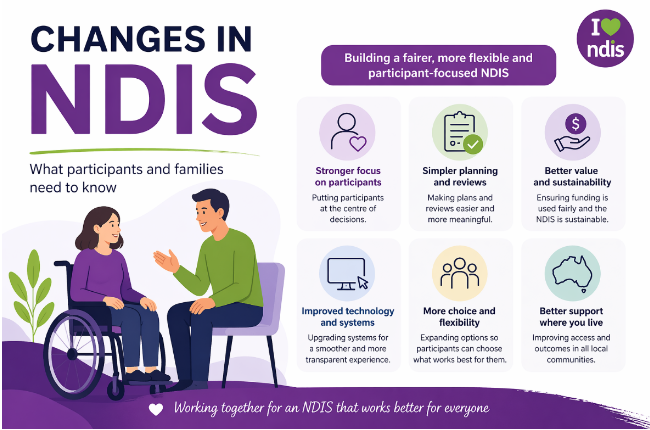
If you or someone you love relies on the National Disability Insurance Scheme, the second half of 2026 is shaping up to be one of the most significant periods in the scheme’s history. From 1 July 2026, the way NDIS plans are assessed, designed, and funded will begin to change in ways that will affect almost every participant eventually — and understanding what is coming is the first step toward making sure your supports remain exactly where they need to be. At Caring Arms Australia, we are a registered NDIS provider committed to keeping the people we support informed, empowered, and well-prepared. Here is everything you need to know about the upcoming changes to NDIS assessment criteria and what the new planning framework means for your day-to-day life. Why Is the NDIS Changing Its Assessment Approach? The existing NDIS planning process has been in place, broadly unchanged, since the scheme launched. Over time, it became clear that outcomes were inconsistent — two participants with almost identical needs could receive very different funding, depending on which planner reviewed their case, which reports they submitted, and how well they navigated the system. The NDIS Review, which consulted thousands of people with disability, families, carers, and providers, confirmed what many already knew: the process needed to be fairer, more transparent, and genuinely person-centred. The new framework is the government’s direct response to that feedback. Rather than relying on functional impairment as the primary lens — essentially, what you cannot do — the new approach shifts focus to what disability-related supports a participant actually needs in their daily life. This is a meaningful philosophical shift, not just an administrative one, and it has the potential to result in plans that better reflect real lived experience. The New Support Needs Assessment: What to Expect The centrepiece of the July 2026 changes is the introduction of a new Support Needs Assessment, which will replace much of the current evidence-gathering process for plan creation. Rather than relying on a collection of reports from treating professionals and lengthy written submissions, participants will instead have a structured conversation with a trained and accredited NDIS assessor. The assessor will meet with participants at a time and place that suits them. Importantly, participants are encouraged to bring family members, carers, or support people to this conversation — this is not a clinical test to pass, but a genuine discussion about daily life and what supports are needed to navigate it. The assessor will use a tool called I-CAN v6 (the Instrument for Classification and Assessment of Support Needs), developed by the University of Melbourne and the Centre for Disability Studies over more than two decades of research in the care sector. This tool is designed to be strengths-based and person-centred, focusing on what kind of support a person needs rather than simply cataloguing their limitations. The assessment report produced from this conversation will directly inform the participant’s NDIS budget. All plans will still be reviewed and approved by trained NDIS staff, and participants will retain their right to request a reassessment or appeal a decision through the Administrative Review Tribunal if they believe the outcome does not reflect their needs. How Plan Budgets Will Change From 1 July 2026 Currently, NDIS plans are organised into three funding categories: Core Supports, Capacity Building, and Capital Supports. Each category has its own rules about what the money can and cannot be spent on, and many participants find the current system rigid and confusing — particularly when their needs don’t fit neatly into one category. From July 2026, new framework plans will move to a simpler two-part structure. The first part is a flexible budget, which participants can use across any approved NDIS supports, giving greater choice and control over how funding is spent. The second part is stated funding, which is designated for specific, higher-intensity supports — such as Supported Independent Living — that require qualified providers and cannot be easily substituted. This restructure is designed to reduce the administrative burden on participants while ensuring the highest-need supports remain properly resourced. Plans will also run for longer periods under the new framework, meaning participants will face fewer routine plan reviews and will have more time and certainty to plan their lives around their supports. Reviews can still be requested at any time if a participant’s circumstances change significantly. Who Will Be Affected First — and When? The rollout will be phased rather than immediate. From 1 July 2026, the NDIS will begin new framework planning with adults aged 18 and over who have less complex support needs. All participants aged 16 and over are expected to be transitioned to new framework plans by October 2029. Participants under 16 will begin transitioning from July 2027, though the Government has acknowledged that no suitable assessment tool for younger children has been finalised yet. Children already enrolled in the NDIS will remain on the scheme during this transition. Changes to access criteria for children under 9 with autism or developmental delay who have lower support needs will not take effect until 1 January 2028 at the earliest, and those changes require separate legislative amendments. If you have a plan review scheduled before 1 July 2026, it will proceed under the current system. Reviews scheduled from July 2026 onward will use the new framework, but only for those in the initial rollout group. Your current plan remains valid until you are personally notified of a transition. There is nothing you need to do right now — the NDIA will contact you directly when your transition is approaching. Mandatory SIL Provider Registration: A Landmark Change for Supported Independent Living Alongside the new planning framework, 1 July 2026 also marks a critical date for Supported Independent Living. From this date, the NDIS Quality and Safeguards Commission is introducing mandatory registration for all SIL providers — including those who have previously operated without registration. This is a significant shift. Until now, the NDIS market has been divided between registered